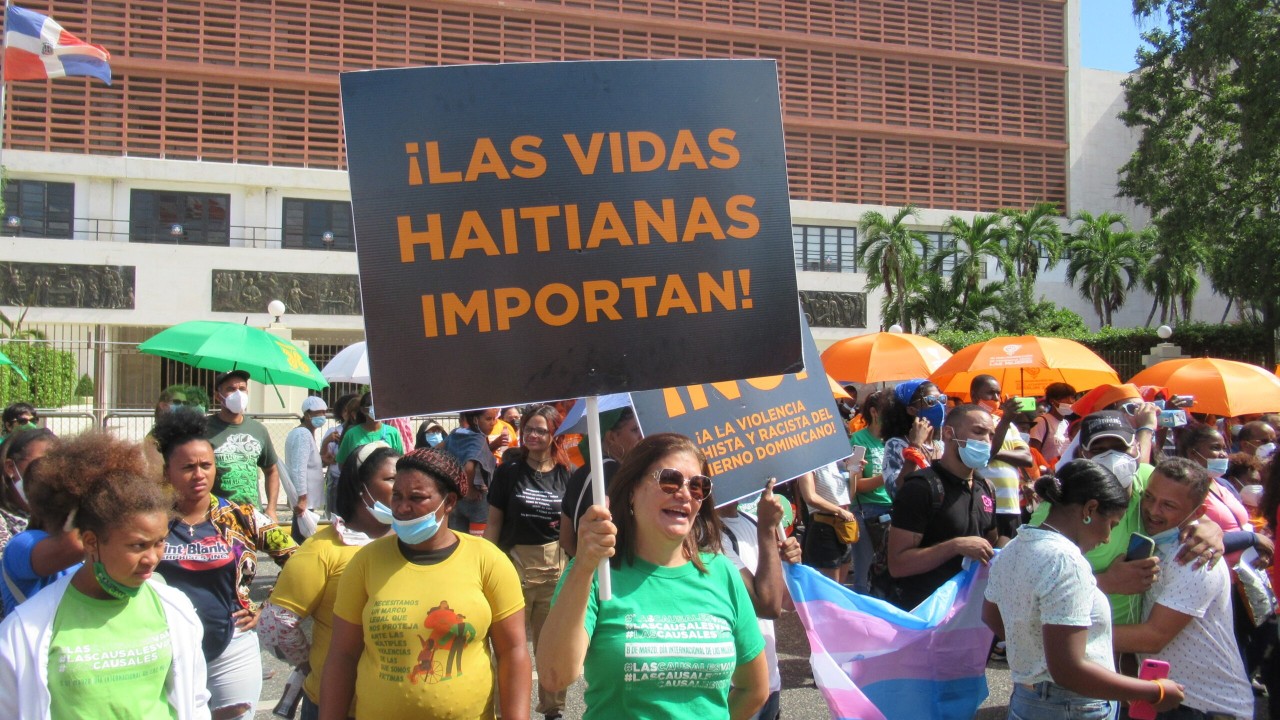
Chasing a dream of safety for my Black child led me from the U.S. to a terrifying confrontation in the Dominican Republic, forcing a profound reckoning with the global nature of prejudice. My journey through the borders of race and belonging reveals that the only true refuge is the one we create through compassion.
There’s a story I used to tell myself about geography and safety. I believed that racism had a specific accent, a particular set of codes, and that by crossing a border, I could find a refuge for myself and the family I was building. Last year, I made the deliberate, heart-wrenching decision to leave the United States. I was terrified of raising a Black child in a country where his value would be constantly questioned, and exhausted by a political climate that felt increasingly volatile. I was tired, down to my bones, of the way my culture, my way of thinking, and my abilities were seen, or more accurately, unseen.
Running a nonprofit had given me a front-row seat to a particular American paradox: a society that professes community but often worships currency. I saw firsthand how the drive for funding and recognition overshadowed the real, gritty work of supporting one another. I felt a profound disappointment in people who promised the world, delivered little, yet still received credit, while those of us who truly invested poured our souls and resources into the work. I didn’t want to give up the mission, but I knew I had to change the soil in which it was growing. I planned to continue the work from closer to my roots, in a place where my son’s future wouldn’t be reduced to a discussion about his hair, his nose, or the complexion of his skin.
This search for a homeland, a safe space, is something the philosopher Gloria Anzaldúa wrote about powerfully in Borderlands/La Frontera. She describes the border not just as a physical line but as a “vague and undetermined place created by the emotional residue of an unnatural boundary.” I was trying to escape the emotional residue of one border, only to find myself squarely in the middle of another. I was living the truth of another of her insights: “The U.S.-Mexican border es una herida abierta [is an open wound] where the Third World grates against the first and bleeds.” My experience taught me that this wound exists far beyond Mexico; it exists wherever the violent fiction of race grates against the humanity of those deemed “other.”

My excitement about leaving the U.S. was palpable, a breath of fresh air as I planned my move from Florida to the Dominican Republic. But that sense of hope was violently shattered during a visit while I was six months pregnant. At the gate of a property I own, a security agent, who had a history of dismissive and racist behavior, escalated to a new level of terror. After hurling insults, “ugly, Black, Haitian”, he saw my pregnant belly and reached for his gun. The threat was immediate, visceral, and specific. It was in that moment, with my life and the life of my unborn child hanging in the balance, that the illusion of a geographic solution shattered.
The irony was cruel. I had left one place fearing for my son’s future, only to face a situation where he might not have a mother at all. And the bitter lesson was this: the racism I encountered there wasn’t fundamentally different from what I sought to escape; it was just less concealed. This is what the Martinican poet and philosopher Aimé Césaire, in his Discourse on Colonialism, so brilliantly exposed: that colonialism (and its progeny, racism) has “decivilized” the colonizer. It has taught them to tolerate, and then to perpetuate, a profound “absence of ethics, of connection, of any human substance.” The security guard’s gun was not an anomaly; it was the logical endpoint of a system that had already abandoned its own humanity.

This series of events, from the misdiagnosis at a hospital that labeled me with a stigmatizing disease I didn’t have, to the Uber driver who deliberately exposed me to immigration checks, forced me to see the global machinery of exclusion. It brought to mind Karl Marx’s concept from the Grundrisse of the “annihilation of space by time.” In our globalized world, the old boundaries of here and there are collapsing, but the hierarchies of race, class, and origin are not. They simply reconfigure themselves, appearing in new forms, whether in Colorado, Santo Domingo, or at a hospital desk. The machinery adapts, but its function to sort, to exclude, to devalue remains the same.
So, I am back in the United States. Not because it is better, but because the nature of the struggle is clearer. Here, the mask is off. The prejudice is less about faking politeness and more about a proud, unvarnished display of power, making the battle lines unmistakable.
This journey has led me to a profound, personal reckoning. I’ve come to understand that the work isn’t about finding a perfect place, because such a place does not exist for people like us. The work is about creating a new reality. The work is about what Aimé Césaire called the “right to a non-negotiable belonging.” We do not need to negotiate our right to exist, to be safe, and to thrive. Our belonging on this earth is inherent. And this brings me back to Gloria Anzaldúa, who gave me the language for my new mission. She writes, “I will have my voice: Indian, Spanish, white. I will have my serpent’s tongue… I will overcome the tradition of silence.” My work now is to use my voice, my Haitian-ness, my Blackness, my womanhood, my passion to overcome the silence imposed by borders.
For my PhD preparation, I’ve been engaging with texts from many traditions, including the Bible. In Genesis 1, there is a powerful, foundational lesson often overlooked: the divine act of creation is an act of radical diversity. The world was not made in a single type or a single color. It was populated with a breathtaking variety of life, matter, and forms, and it was all declared “very good.” This isn’t a matter of faith, but a matter of principle: diversity is not a political agenda; it is the fundamental character of our world. It is the original blueprint. If only we could all return to that basic understanding, that we, in all our magnificent variations, are all part of that “very good.”This “open wound” exists wherever people are told they do not belong. I found mine at a gate in the Dominican Republic.Gloria Anzaldúa, Borderlands/La Frontera. Her words gave name to the wound I experienced.

The Lesson in the Labyrinth
My search for a safe home led me in a circle, but it was not a futile journey. It taught me that the border is not just a line on a map; it is a condition of being for those who are told they do not belong. And the only way to dismantle it is to build from within.
The lesson is this: We cannot outrun the world’s problems by changing countries. We can only out-build them by changing consciousness. The mission of my nonprofit remains, but its purpose has deepened. It is no longer just about the projects we deliver, but about fostering the compassion, understanding, and unwavering commitment to diversity that I found so lacking.
The world will be a better place one day, not because we found a haven, but because we made one. We make it by leading with compassion in our communities, by demanding accountability in our institutions, and by remembering, always, that our shared humanity is the only homeland that truly matters. The work continues, not over there, but right here, wherever we are, with a renewed and unshakeable purpose.
Womenful Voice International Commission for Equity & Peace (ICEP)
Leave a Reply